
The Web Framework Vulnerability Surge (2020-2026)
In the rush to build faster, more interactive digital experiences, the UK’s SME sector has leaned heavily on modern web frameworks like React, Next.js, and Vue. While these tools have revolutionized development, the Mondoo 2026 State of Vulnerabilities Report reveals a sobering reality: our digital foundations are more fragile than we think.
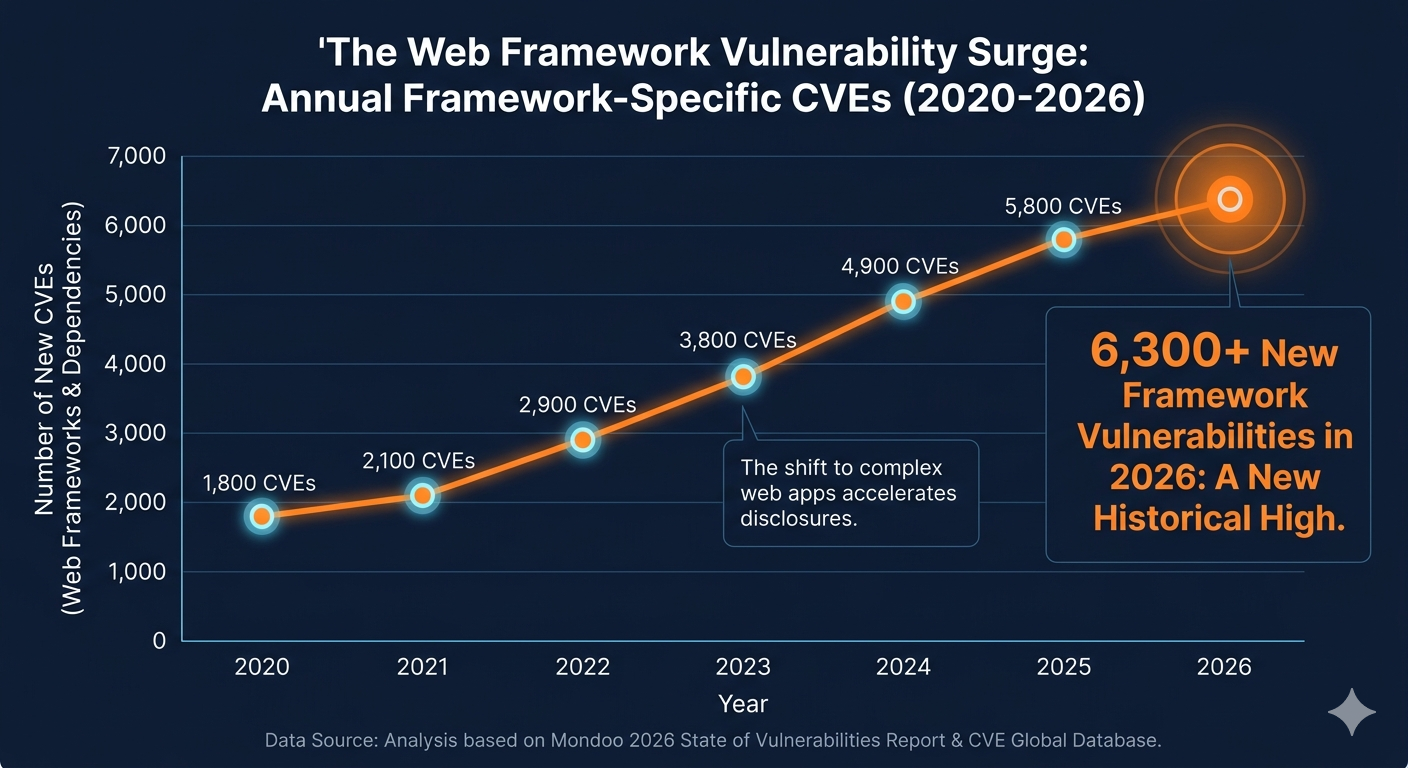
In 2026, Cross-Site Scripting (XSS) and framework-level vulnerabilities have officially claimed the top spot as the most frequent threat to business web estates, with over 6,300 documented cases this year alone.
But to understand why this matters, we first have to understand the language of the attacker: the CVE.
What exactly is a CVE?
CVE stands for Common Vulnerabilities and Exposures. Think of it as an international "Most Wanted" list for software flaws.
Launched in 1999, the CVE system provides a standardized way for security researchers to identify and name specific weaknesses in software. Each vulnerability is given a unique ID (e.g., CVE-2026-12345) and a severity score. This allows IT teams across the globe to speak the same language when a new threat emerges.
The 2026 Problem: While the CVE system is essential, it has become a victim of its own success. In the early 2000s, only a few hundred CVEs were issued per year. In 2026, we are seeing over 130 new CVEs published every single day. For an SMB owner, keeping up with this "vulnerability firehose" manually is physically impossible.
The "Mosaic" Risk: Why Frameworks are Targeted
Modern websites are rarely built "from scratch." Instead, they are a mosaic of third-party packages and web frameworks. When you use a framework like React, you aren't just using code written by Meta; you are using hundreds of smaller "dependencies" (sub-packages) maintained by individual developers around the world.
If a single one of those 6,300+ CVEs appears in a deep, nested dependency of your web framework, your entire site is potentially compromised. Attackers love this "One-to-Many" ratio. By finding one flaw in a common framework, they gain a master key to millions of small business websites simultaneously.
Visualizing the Surge: The 6,300+ Threshold
The growth in framework-specific vulnerabilities is not linear—it is exponential. As frameworks become more complex, the "Attack Surface" (the number of places an attacker can poke) expands.
The Need for Continuous, Agentic Oversight
If 130 new CVEs are published daily, a "monthly scan" is functionally useless. If a critical XSS vulnerability is published on the 2nd of the month and your scan isn't scheduled until the 30th, you have left your doors unlocked for 28 days.
This is why CyberSentrx focuses on Autonomous Continuous Mapping.
Our platform doesn't just run a checklist; it utilizes Agentic Intelligence that is constantly fed by the latest CVE streams and dark web insights. As soon as a framework vulnerability is disclosed, CyberSentrx re-evaluates your entire web estate to see if you are affected—not next month, but now.
The CyberSentrx Approach:
Continuous Discovery: We find the sub-packages and frameworks your developers might have forgotten were running.
Real-Time Triage: We cross-reference the 6,300+ newest CVEs against your specific code-base.
Proactive Remediation: We don't just send you a "Most Wanted" list; we tell you exactly which line of code to patch to close the door before the 1.6-day exploitation window shuts.
In 2026, your web estate is either being scanned by you or it's being scanned by an attacker. With CyberSentrx, you make sure you find the cracks in your foundation first.
Learn more at