

If your security strategy relies on human-led triage and linear patching, you are already too late.
For years, the advice given to UK SMBs regarding cybersecurity was simple: "Get an annual penetration test, run a vulnerability scan once a month, and patch the Criticals (the 9.0s and 10.0s) within 30 days."
In 2023, that was arguably "best practice." In 2026, that advice is a death sentence for your business.
The ground has shifted completely. Attackers are no longer lone hackers manual probing systems; they are utilizing Agentic AI to automate reconnaissance and exploitation at machine speed. The data from the Mondoo 2026 State of Vulnerabilities Report and recent CVE metrics confirms that the "Window of Opportunity" for defenders has not just shrunk—it has collapsed entirely.
If your security strategy relies on human-led triage and linear patching, you are already too late.
Here are the three high-velocity insights from the 2026 data that prove why continuous, autonomous web vulnerability scanning is no longer a "luxury" item, but the cornerstone of SMB survival.
Pillar 1: The Collapse of "Time-to-Exploit" (The 1.6-Day Deadzone)
The most defining metric of 2026 is speed.
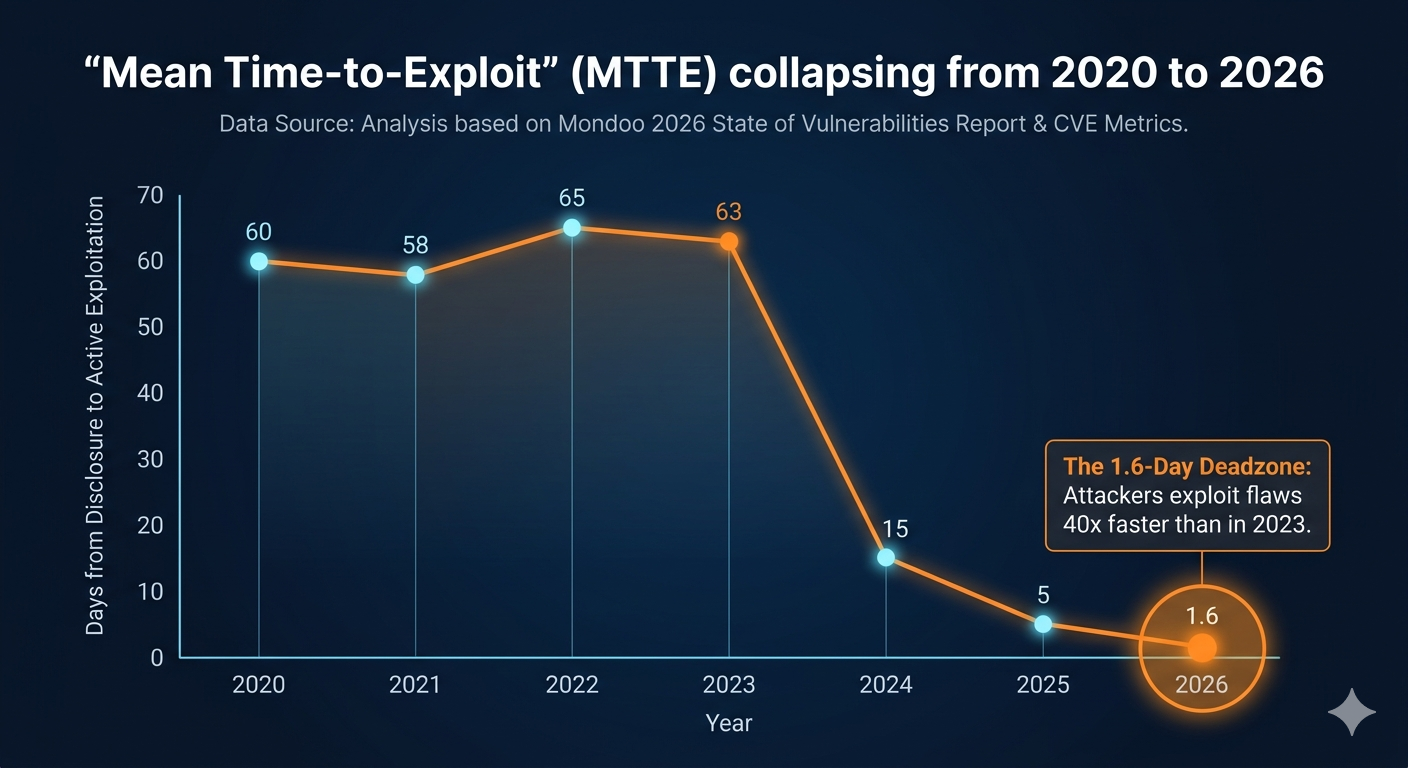
Historically, defenders had weeks, sometimes months, to react to a newly published vulnerability (CVE) before attackers could weaponize it. As recently as 2023, the Mean Time-to-Exploit (MTTE) was approximately 63 days.
Today, that figure has collapsed to between 1.6 and 5 days.
This means that from the moment a vulnerability is publicly disclosed, an automated AI agent used by threat actors can identify, test, and exploit that specific flaw across the entire internet in less than 48 hours.
The Insight for SMBs: If you are running monthly scans, you are, on average, 25 days too late. An annual penetration test is merely a historical snapshot of how vulnerable you used to be. To survive in 2026, you need a system that can map your attack surface, identify new vulnerabilities, and re-prioritize your risk continuously. You are not racing against other businesses; you are racing against a 1.6-day clock.
Pillar 2: The "CVSS Blind Spot" and the Failure of Traditional Prioritization
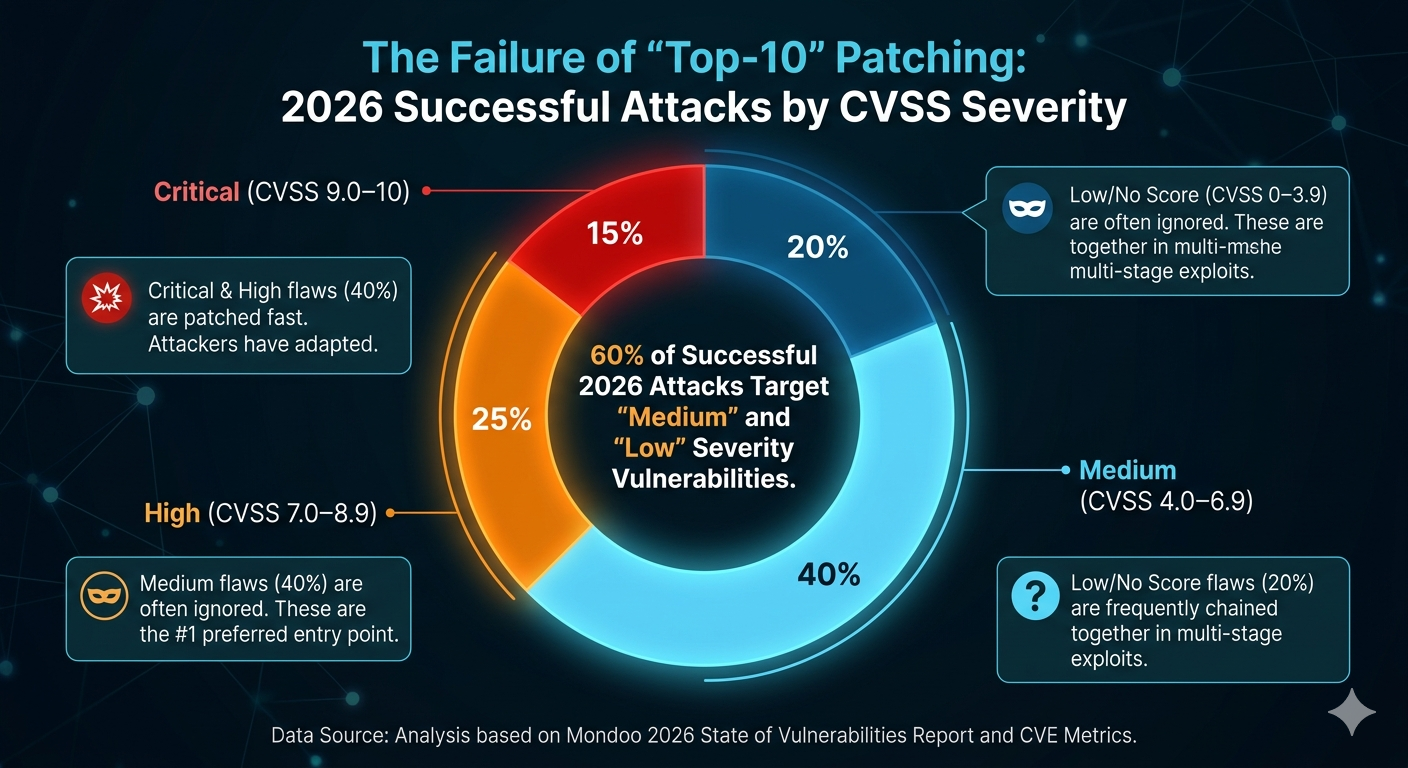
For decades, IT teams have prioritized patching based on the Common Vulnerability Scoring System (CVSS)—the 1–10 score that tells you how "bad" a bug is. The standard operational procedure is "Fix the 10s and 9s, and ignore the 4s and 5s."
The 2026 data proves this is a fatal strategic flaw.
Attackers are now actively avoiding Critical-rated vulnerabilities. Why? Because they know every automated system and IT team is focused on patching them immediately. Instead, they are automating the exploitation of "Medium" (CVSS 4.0–6.9) vulnerabilities. By chaining three or four "Medium" flaws together, they can achieve the same result as a "Critical" exploit (e.g., remote code execution), but they can do it undetected because those lower-level flaws are often left unpatched for months.
Furthermore, 11% of all new vulnerabilities in 2026 are published with no CVSS score at all. If your prioritization logic is "show me the 10s," your scanner is functionally blind to a significant percentage of the active threat landscape.
The Insight for SMBs: You cannot "patch your way out" of this problem by simply chasing high scores. You need Recontextualization. An autonomous scanner (like CyberSentrx) doesn't just see a "5.0" bug; it uses Agentic Logic to determine if that 5.0 bug is sitting on your main customer-facing portal and if it can be used to escalate privileges. The future isn't about finding more bugs; it’s about knowing which ones actually matter to your business.
Pillar 3: Identity is the New (and Preferred) Vulnerability
Traditional scanners look for software flaws—a missing patch, a misconfiguration, or an open port. Attackers in 2026 have moved beyond "breaking in." They have realized that the easiest way into an SMB is to simply "log in."
The Mondoo 2026 Report confirms that 70% of all cloud and web breaches this year originated from compromised identities—not software vulnerabilities.
Attackers are using the massive influx of 2026 dark web leaks (from sectors like Fintech and Healthtech) to feed their AI-driven "Credential Stuffing" bots. They take a leaked password from a third-party breach and test it autonomously against your website, your VPN, and your SSO (Single Sign-On) portals within minutes of the leak appearing underground.
The Insight for SMBs: A software vulnerability scan that does not include External Identity Threat Detection is only doing half the job. Your biggest risk isn't necessarily a flaw in your code; it’s that your CEO’s password just appeared on a Russian hacker forum. Your "web scanner" must be an all-encompassing monitor that connects your public-facing code vulnerabilities with your team's exposed digital identities.
Conclusion: The Need for an "Autonomous Guardian"
The data from 2026 is clear. The threats are automated, intelligent, and relentless. The "1.6-Day Race" is not a sprint; it’s a non-stop endurance battle.
For the UK’s 5.5 million SMBs, the traditional "manual, linear, checkbox" approach to security is no longer viable. It is too slow, too shallow, and too expensive. The only path forward is to deploy an Autonomous Guardian—an AI-led platform that operates at the same speed as the attacker, continuously mapping, re-contextualizing, and defending your attack surface.
The data shows that the attackers have already automated. The question is: When will you?
About CyberSentrx Limited
CyberSentrx is a UK-based, Innovate UK-backed pioneer in Autonomous External Threat Exposure Management (CTEM). We are building the "Autonomous Guardian" platform, shifting SMB resilience from passive scanning to agentic reconnaissance.
Learn more at