
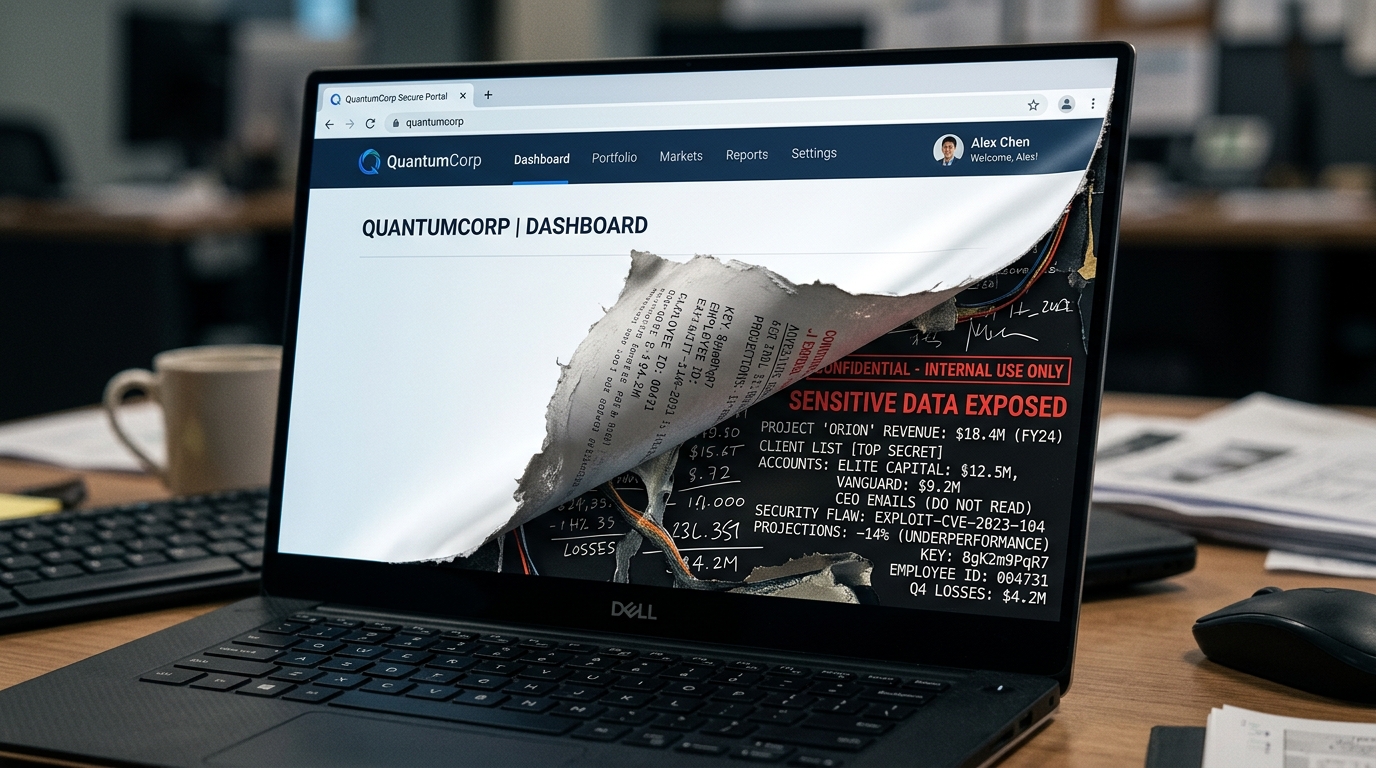
Your website is constantly “talking” — and not just to your customers.
Your website might look polished, secure, and professionally managed. But beneath the surface, it could be quietly revealing information to cyber criminals. Information that helps them understand your systems, identify weaknesses, and plan attacks. The uncomfortable truth is your website is constantly “talking”, and not just to your customers.
For CEOs and business leaders, this creates a hidden layer of risk. Because what your website reveals behind the scenes can be just as important as what it shows on the front page.
What Your Website Is Really Saying
Every public-facing website exposes technical and structural information, whether you intend it to or not. To an attacker, your website is not just a digital storefront, it is a rich source of intelligence. This includes software versions and frameworks, server configurations and API endpoints and integrations. Individually, these may seem harmless.
But collectively, they provide attackers with a blueprint of your digital environment.
The Three Silent Risk Areas
1. Unnoticed Vulnerabilities
Many websites rely on content management systems (CMS) using plugins and extensions with third-party scripts. If these components are outdated or unpatched, they can introduce known vulnerabilities.
Attackers actively scan the internet for known CVEs (Common Vulnerabilities and Exposures) from outdated software versions using weak encryption protocols. Once identified, these vulnerabilities can often be exploited quickly and at scale.
2. Misconfigurations
Even well-maintained systems can be undermined by configuration issues. Common examples include exposed admin panels with open ports and services or missing HTTPS enforcement.
These are often unintentional but highly visible to attackers using automated scanning tools.
3. Exposed Metadata
Metadata is one of the most overlooked risks. Your website may reveal internal file paths, developer comments, technology stacks and usernames or system references.
Even something as simple as a document uploaded to your site can contain hidden metadata that could expose employee names and internal systems documentation. For attackers, this is valuable reconnaissance data.
How Attackers Use This Information
Modern attackers don’t guess, they analyse. They combine data from your website with other sources such as social media profiles, domain registrations and dark web leaks.
This allows them to identify vulnerable systems and target specific employees to exploit known weaknesses. What your website reveals becomes the starting point for a much larger attack.
Real-World Examples
These risks are not theoretical. Many organisations have experienced significant impact due to what their websites exposed.
British Airways (2018) — Website Script Injection
Attackers injected malicious JavaScript into the British Airways website, capturing customer payment details.
What made it possible? There were weaknesses in web application security from a lack of detection of injected scripts
What was the impact? Over 400,000 customers affected that resulted in a £20 million regulatory fine leading to long term reputational damage.
Equifax (2017) — Unpatched Web Vulnerability
Equifax suffered one of the largest data breaches in history due to an unpatched vulnerability in a web application framework.
What made it possible? Equifax had failed to patch a known vulnerability in a public-facing system.
What was the Impact? 147 million individuals were affected resulting in hundreds of millions in costs.
Magecart Attacks — Ongoing E-commerce Threat
Magecart groups have compromised thousands of websites by injecting malicious code into checkout pages. They look for vulnerable third-party scripts and target businesses that have weak monitoring of website integrity. Their goal is to steal payment data for financial fraud. They are still active and have likely scanned your website in the past 12 months.
Why You May Not Know It’s Happening
One of the biggest challenges is that these issues are often invisible internally. Your website may appear to function normally with customers not immediately noticing issues. Security tools may not monitor external exposure that results in changes to your website.
Meanwhile, attackers can see everything. This creates a dangerous imbalance. They understand your risk better than you do.
The Cost of Silence
When your website is “talking behind your back,” the consequences will be an increased likelihood of cyber attacks. You could be at risk right now of someone being able to rapidly exploit these vulnerabilities and damage your brand trust and reputation.
And because the signals are subtle, organisations often only become aware after an incident has occurred.
Why CEOs Should Care
Your website is one of your most visible and valuable business assets. But it is also one of your most exposed. For CEOs, this is not just a technical concern, it is a business risk issue that threatens every aspect of your business.
Understanding what your website is revealing is critical to protecting your organisation.
Turning Visibility into Control
The key to reducing risk is not just securing your website, it is understanding how it appears to attackers. This requires continuous monitoring of public-facing web assets to identify vulnerabilities and misconfigurations.
Without this visibility, organisations are effectively operating blind.
How CyberSentrx Helps You Take Back Control
CyberSentrx provides organisations with a clear view of what their website — and broader digital footprint — is revealing externally.
The platform continuously monitors:
Public Web Vulnerabilities
Identifying weaknesses and outdated components visible to attackers.
Misconfigurations and Exposure
Detecting exposed services, insecure settings, and hidden risks.
Metadata and Digital Footprint Analysis
Highlighting information that could be used for reconnaissance or social engineering.
AI-Driven Remediation Guidance
Providing clear, prioritised steps to fix vulnerabilities quickly.
Continuous Monitoring
Ensuring that new risks are identified as your digital environment evolves.
Rather than discovering issues after attackers exploit them, CyberSentrx enables organisations to identify and resolve risks proactively.
Learn more at:
Your website will always reveal something. The question is whether you understand what that is and what it means. Because in today’s threat landscape, attackers are listening closely.
Final Thought
Your website may not be saying anything to you. But it is constantly communicating with the outside world. And if you’re not paying attention, it may be telling attackers exactly what they need to know. To understand what your website is revealing and how to reduce the risk before it’s exploited visit:
Because in cybersecurity, what you don’t see can absolutely hurt you.
Related Articles
For more information on the importance of website vulnerability management read our article on "The real cost of website vulnerabilities to your brands reputation"