Today, initial access brokers and cyber criminals are bypassing traditional authentication controls altogether.
For years, security teams treated password management as their primary line of defense against unauthorized access. If an enterprise mandated 16-character passwords, complex symbols, and Multi-Factor Authentication (MFA), corporate accounts were considered reasonably safe.
That model is no longer enough.
Today, initial access brokers and cyber criminals are bypassing traditional authentication controls altogether. They aren't brute-forcing passwords or cracking hashes; they are purchasing complete, pre-authenticated user sessions traded in stealer logs.
Here is how information-stealing malware works, why stealer logs have become the primary currency of the dark web, and how modern enterprises can protect themselves before stolen credentials turn into full-scale account takeovers.
What Are Stealer Logs?
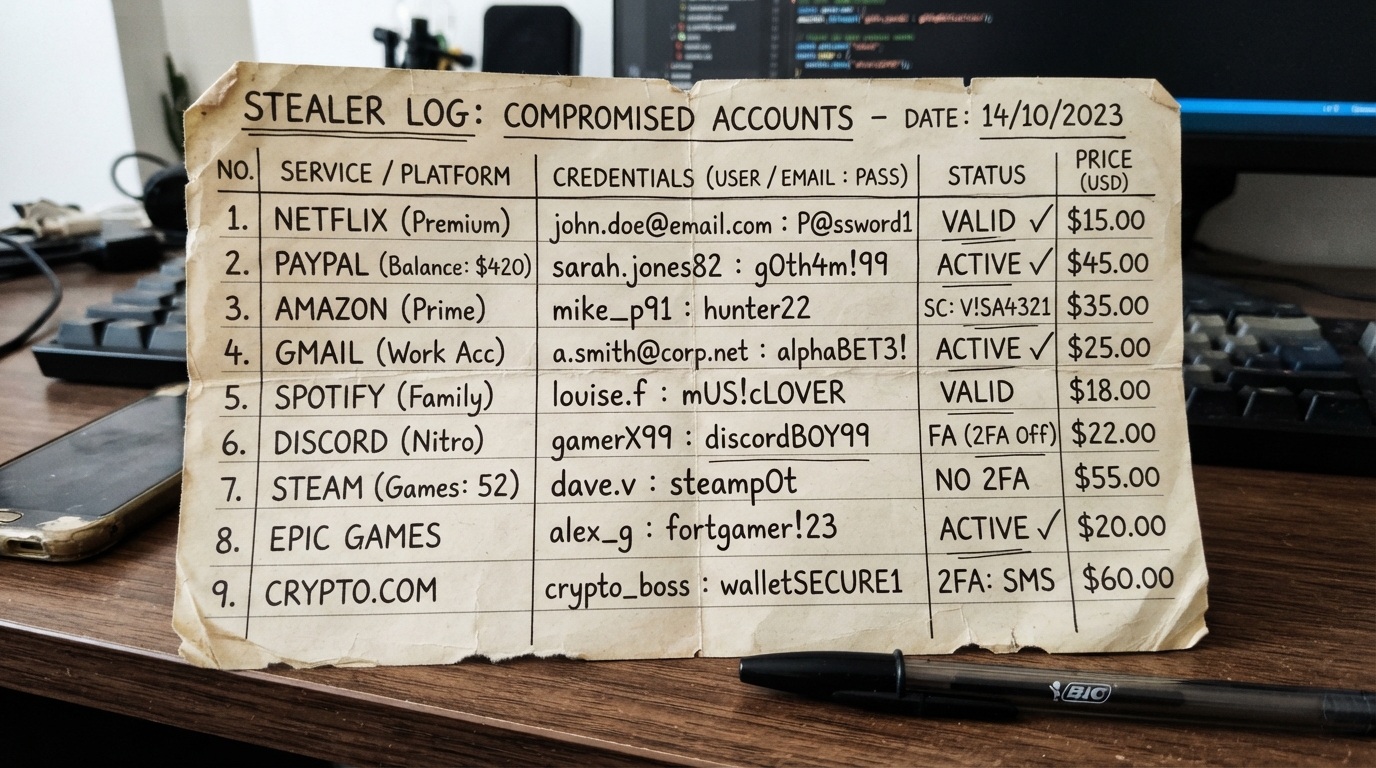
A stealer log is a packaged text or JSON file generated by InfoStealer malware (such as Lumma, RedLine, Raccoon, or Vidar) after compromising a device.
When a user accidentally downloads an InfoStealer—often via a malicious search ad, trojan software installer, or phishing link—the malware silently scrapes sensitive data stored across the device. Rather than encrypting files like ransomware, InfoStealers act as quiet reconnaissance tools.
A typical stealer log contains far more than a simple username and password. It packages:
Browser Autofill & Stored Passwords: Plaintext credentials saved in Chrome, Edge, Firefox, or Safari.
Active Session Cookies: Valid, live session tokens that allow attackers to clone an authenticated browser state.
System Fingerprints: IP addresses, browser versions, operating system details, user agent strings, and hardware IDs.
Cryptocurrency Wallets & Extension Data: Secret recovery phrases and browser extension storage files.
Corporate VPN & SSO Portals: Saved endpoints for Okta, Azure AD, AWS console logins, and internal tools.
Once generated, these logs are automatically sent to a command-and-control (C2) server, aggregated, and listed for sale on dark web marketplaces or automated Telegram channels within minutes.
Why Stealer Logs Are Bypassing MFA
The most dangerous element of a modern stealer log isn't the password—it’s the session cookie.
When an employee logs into a corporate SaaS application using MFA, the server issues a session cookie to the browser. This token proves to the server that the user successfully passed the authentication check and doesn't need to re-verify for every action.
When InfoStealers harvest active session cookies alongside system metadata, attackers perform an Adversary-in-the-Middle (AiTM) or Session Hijacking attack. By importing the stolen cookies into a custom browser matching the victim's fingerprint, the attacker tricks the cloud provider into thinking the legitimate employee is resuming a session.
The Result: The attacker logs straight into the corporate environment—bypassing password prompts, SMS codes, and push notifications entirely.
The Dark Web Ecosystem: How Stealer Logs Are Traded
Stealer logs are traded at scale through automated illicit platforms:
Automated Telegram Bots: Channels run by cybercriminals automatically post parsed log feeds filtered by target domain.
Dark Web Marketplaces: Automated stores allow buyers to search by domain, country, or specific SaaS access (e.g., "Find active logins for Salesforce + corporate email domain").
Initial Access Brokers (IABs): Specialized threat actors buy bulk stealer logs, identify high-value enterprise targets, test the session cookies, and sell confirmed initial access to ransomware deployment teams for thousands of dollars.
Because an individual log costs anywhere from $2 to $20, the ROI for an attacker is immense. A single infected personal laptop used by a remote worker or contractor can expose access points to an entire enterprise network.
4 Steps to Mitigate Stealer Log Exposure
Securing your organization against stealer logs requires moving beyond basic identity management and focusing on continuous external exposure tracking.
1. Invalidate Session Tokens Immediately
When credentials or cookies appear in dark web feeds, simply forcing a password reset isn't enough. Security teams must terminate all active sessions across corporate Identity Providers (IdPs) like Okta, Azure AD, and Google Workspace to invalidate stolen session cookies.
2. Implement Device Health Checks & Conditional Access
Enforce strict Zero Trust device compliance policies. Ensure users can only access corporate applications from managed devices running verified endpoint security software, making stolen cookies useless on unauthorized hardware.
3. Transition to FIDO2 / WebAuthn Hardware Keys
Traditional MFA (SMS, push notifications, TOTP apps) can be intercepted by phishing proxies or bypassed via stolen session tokens. FIDO2-compliant security keys (like YubiKeys) bind authentication directly to the origin domain, significantly reducing the success rate of credential-harvesting frameworks.
4. Gain Real-Time Visibility into Dark Web Leaks
Attackers act fast once a log hits the market. Waiting for an internal security alert often means reacting after access has already been established. Organizations need continuous dark web intelligence that identifies corporate email addresses, passwords, and compromised session tokens the moment they appear in underground marketplaces.
Proactive Defense with CyberSentrx
Detecting stolen corporate credentials before an initial access broker exploits them requires constant surveillance outside your network perimeter.
CyberSentrx provides comprehensive, automated dark web monitoring at an affordable price for SMEs and all business users. By continuously tracking criminal forums, dark web marketplaces, Telegram leak channels, and stealer log feeds, CyberSentrx identifies exposed corporate credentials, leaked employee data, and compromised session logs in real time.
Instead of sifting through thousands of irrelevant breach notifications, CyberSentrx converts raw dark web intelligence into clear, actionable remediation recommendations—allowing your IT and security teams to reset credentials, invalidate active sessions, and seal external attack paths before attackers strike.